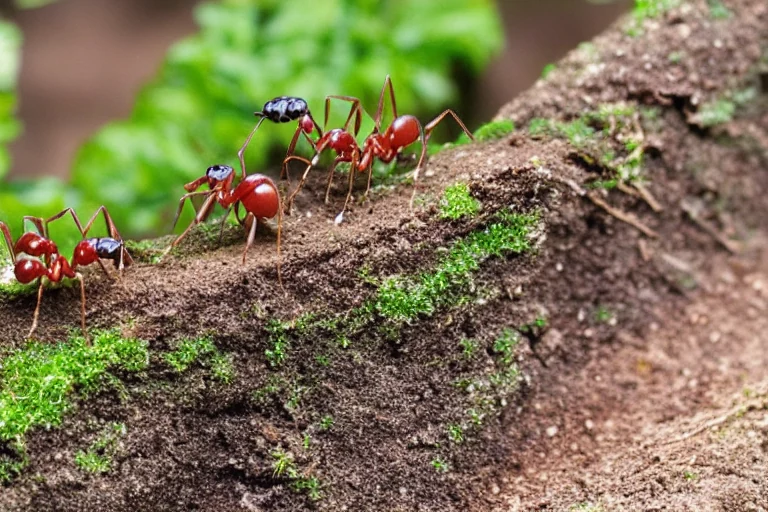
Introduction to Ants and Their Societies
Ants are highly organized insects that live in colonies. These colonies can range from a few dozen to millions of individuals, each with specific roles and responsibilities. This section will explore the basics of ant life and introduce the key concepts of colony organization and communication. [7]
Communication Methods Among Ants
Ants use a variety of communication methods, including chemical signals (pheromones), tactile interactions, and possibly auditory signals. This section will delve into the role of pheromones in guiding ants to food sources and maintaining colony organization. [7]
Division of Labor in Ant Colonies
Ant colonies are highly organized, with different castes performing specific tasks. This section will explain how ants organize their colony structure and division of labor, highlighting the efficiency and adaptability of their social system. [2]
Pheromones and Navigation
Pheromones play a crucial role in ant navigation and foraging. This section will provide examples of how ants use pheromones to find food and navigate their environment, including the construction of complex structures and the use of living bridges. [7]
Practical Significance of Ant Communication and Organization
The communication and organization of ants have inspired innovations in technology and engineering. This section will explore how these natural phenomena can inform the development of swarm robotics and self-healing materials. [6]
Key Takeaways
- Ants use chemical signals (pheromones) to communicate and organize their colonies.
- Division of labor in ant colonies is highly specialized, with different castes performing specific tasks.
- Pheromones are essential for guiding ants to food sources and maintaining colony organization.
- Ants can build complex structures and living bridges using simple rules and interactions.
- The study of ant communication and organization has practical applications in technology and engineering.
FAQ
- **What are the primary methods of communication among ants in a colony?** Ants primarily use chemical signals (pheromones), tactile interactions, and possibly auditory signals to communicate. [7]
- **How do ants organize their colony structure and division of labor?** Ant colonies are organized with different castes performing specific tasks, ensuring efficient and adaptable social systems. [7]
- **What evidence supports the role of chemical signals in ant communication?** Pheromones are essential for guiding ants to food sources and maintaining colony organization, as demonstrated by their use in foraging and navigation. [7]
- **Can you provide examples of how ants use pheromones for navigation and foraging?** Ants use pheromones to find food and navigate their environment, including the construction of complex structures and the use of living bridges. [6]
- **What practical significance do the communication and organization of ants have for human technology and engineering?** The study of ant communication and organization has inspired innovations in swarm robotics and self-healing materials. [5]
Conclusion
The secret life of ants reveals a highly organized and efficient social system that has inspired technological advancements. By understanding the communication and organization of ants, we can develop more effective and adaptive technologies for various applications. [7]